TV’s TV was a four-hour late-night television program broadcast in Japan on Fuji TV from 01:55 to 05:55 on Saturday, March 14, 1987. It was a televisual predecessor to a book that I also discuss below, and an early sign of the experimental programming that Fuji TV would formalise later that year with its JOCX-TV2 late-night brand—a slot explicitly created to give young creators room to experiment.
The program comprised 100 TV spots, presented as a wall of TVs, showcasing a range of video games from around the world. For many Japanese viewers, it was their first encounter with the Amiga, Apple II, and Atari.
The creative credits read like a who’s who of future Japanese media innovators. Toshio Iwai (Otocky, SimTunes, Electroplankton, Tenori-on) created the CG using an Amiga. Masaya Matsuura (The Seven Colors: Legend of PSY·S City, PaRappa the Rapper, Vib-Ribbon) composed the music. The show’s production was overseen by Tsunekazu Ishihara—now president of The Pokémon Company—who would go on to direct the book that followed.
TV’s TV ushered in a new way of looking at television, not only because it introduced Western computers and games to a Japanese audience, but because it did so in a format that was itself playful and game-like.
There’s a full table of contents in the description of the video below.
But don’t watch the 4 hours yet! Read on.
テレビゲーム―電視遊戯大全 / TV Games Encyclopedia (1988)
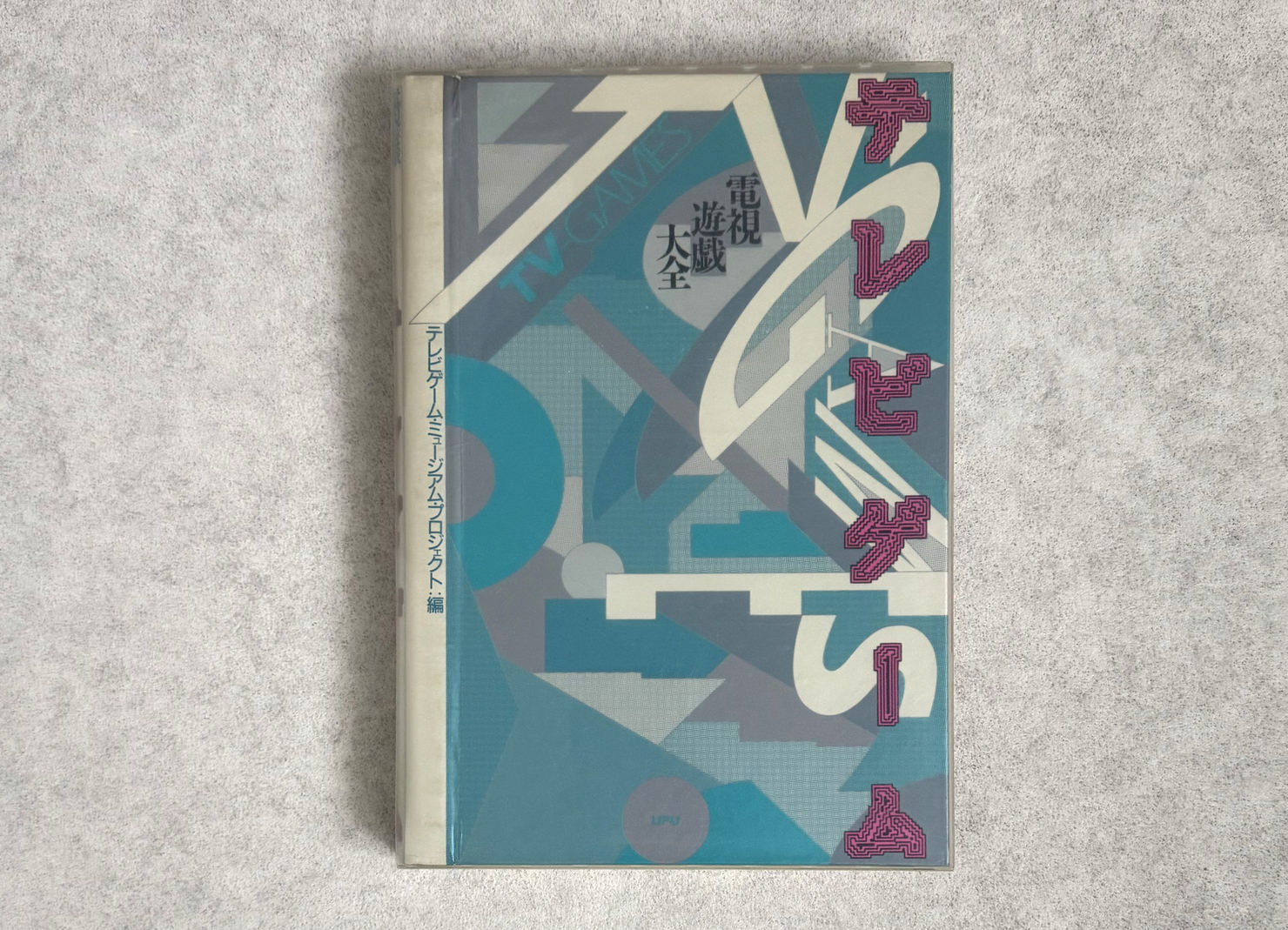
The following year, the team behind TV’s TV channelled that same energy into print. The result might be described as a book, but it’s much more than that. テレビゲーム―電視遊戯大全 (TV GAMES: Denshi Yūgi Taizen; TV Games Encyclopedia), published in May 1988 by UPU, ISBN4-946432-31-0, was a seminal encyclopedia of video game history—and perhaps the single most ambitious book about games ever produced.
It arrived right in the middle of Japan’s bubble economy. Between roughly 1986 and 1991, a combination of rock-bottom interest rates and rampant speculation sent asset prices into the stratosphere. Money was everywhere and it was looking for things to be spent on.
This was the era when Japanese corporations bought Rockefeller Center and Columbia Pictures. When golf club memberships traded for the price of houses. When the land beneath the Imperial Palace in Tokyo was theoretically worth more than the entire state of California. Consumer spending went through the roof: credit card circulation tripled, luxury imports quadrupled, and the art market went berserk—Japanese buyers paid record sums at auction for Renoirs and Van Goghs just because they could.
The cultural side-effects were extraordinary. Bubble-era money funded some of the most ambitious, beautiful, and outright weird creative projects Japan has ever produced. Architecture, graphic design, magazines, vehicles, music, fashion, animation—everything was touched by the sense that budgets were infinite and ambition should match. It’s no coincidence that this period overlaps with the golden age of Japanese game development, or that Fuji TV was handing late-night airtime to young experimentalists, or that someone thought a four-hour TV program about Western computer games was a good idea.
The TV Games Encyclopedia is very much a product of this moment. Its lavish physical production—the frosted plastic slipcase, the variety of paper stocks, the multiple print techniques and finishes—reflects the kind of excess that was not only possible but expected. A book about video games had no business being this beautifully made. And yet here it was, priced at ¥3,500, with the ambition and budget of an art object. When the bubble burst in 1991—ushering in what became known as the Lost Decades—this kind of thing simply stopped being made.
The object
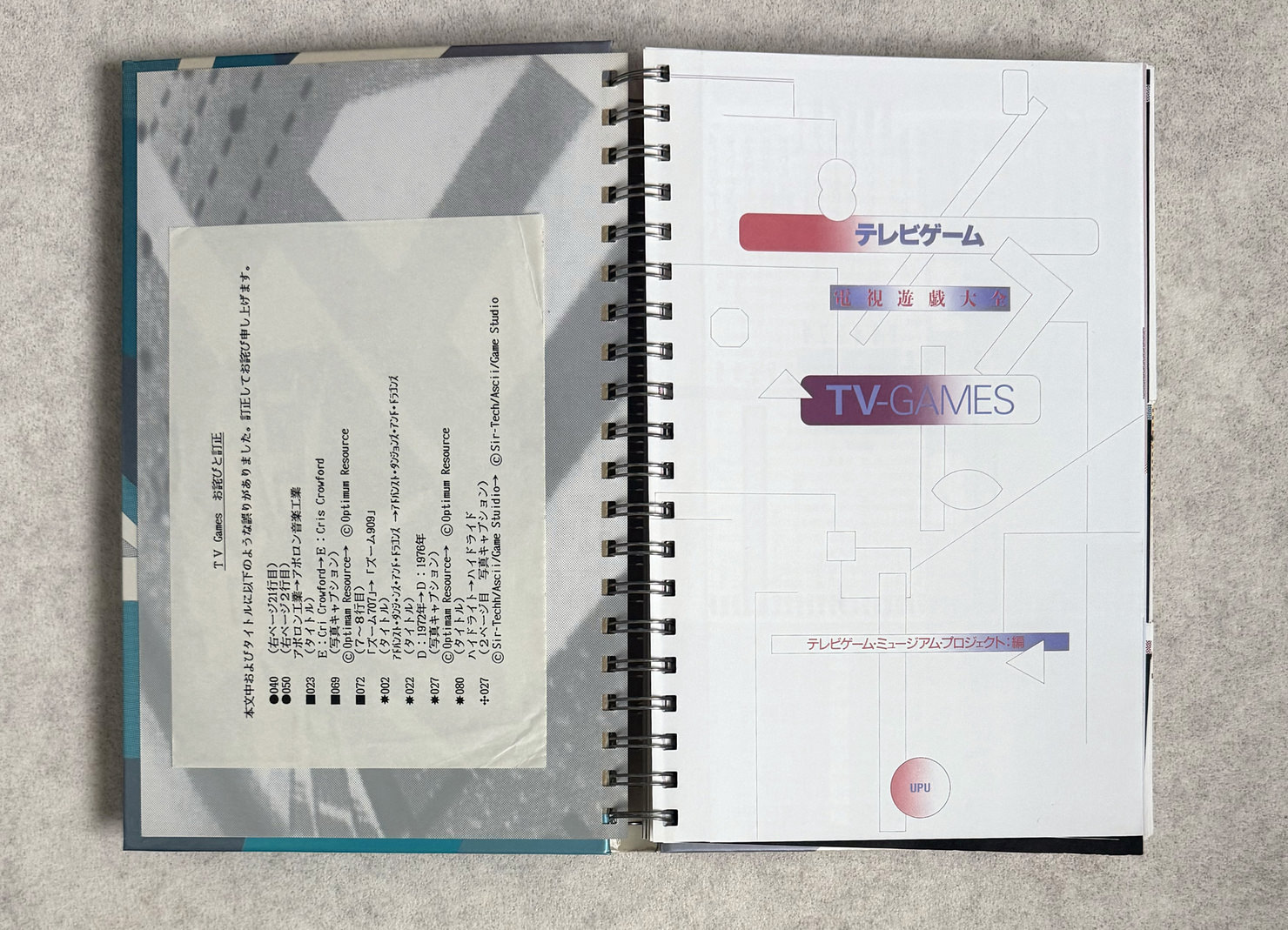
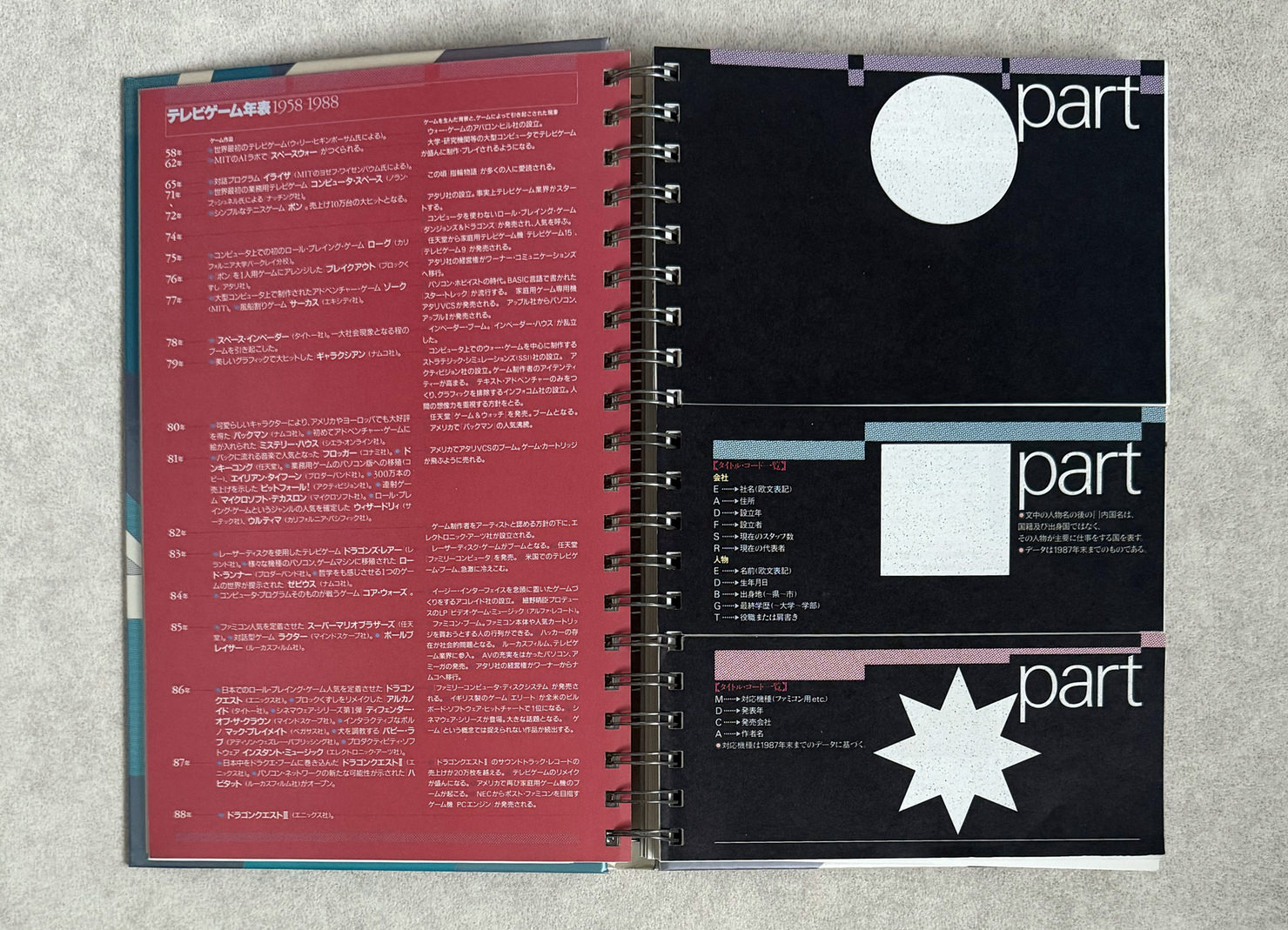
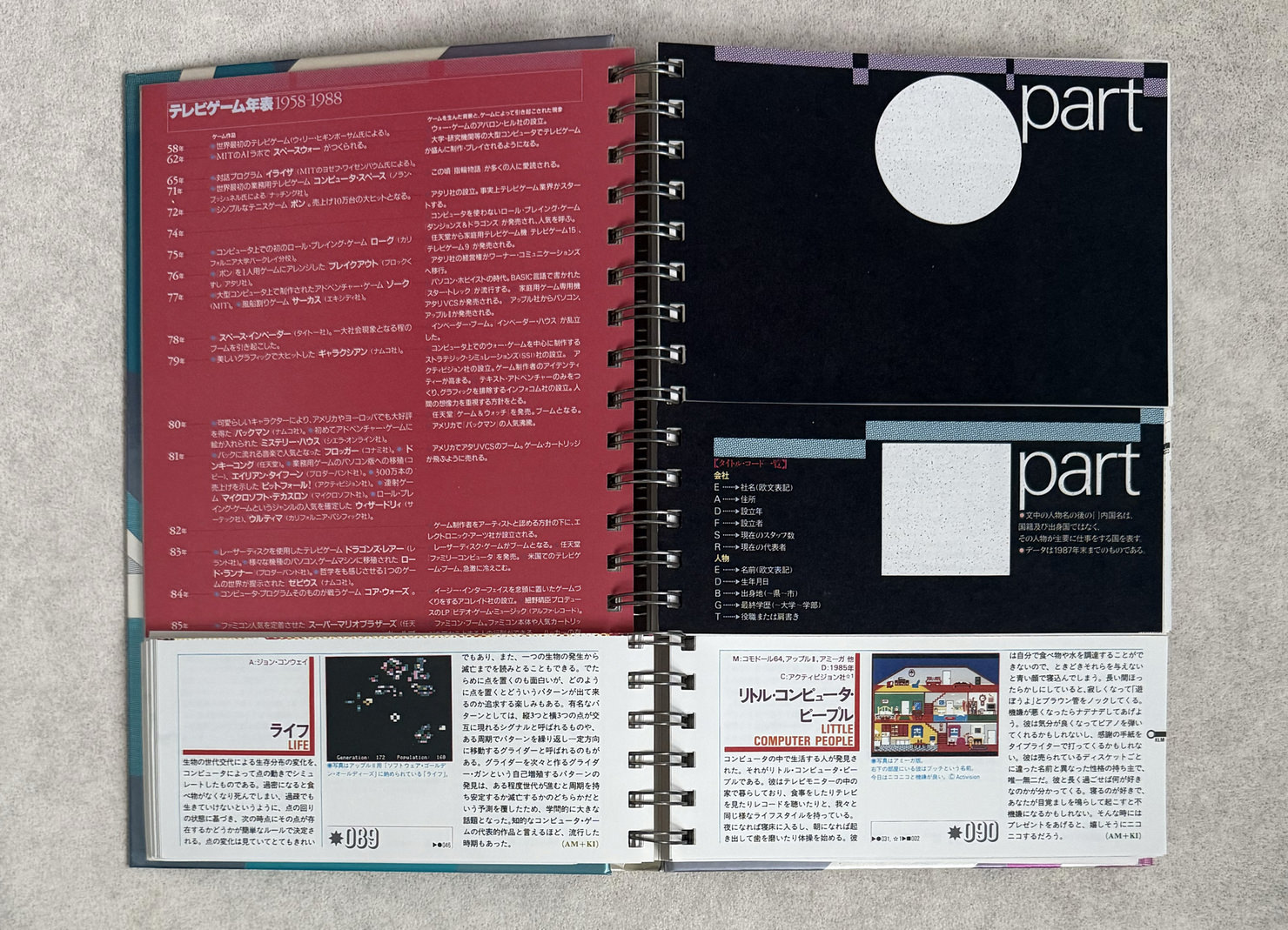
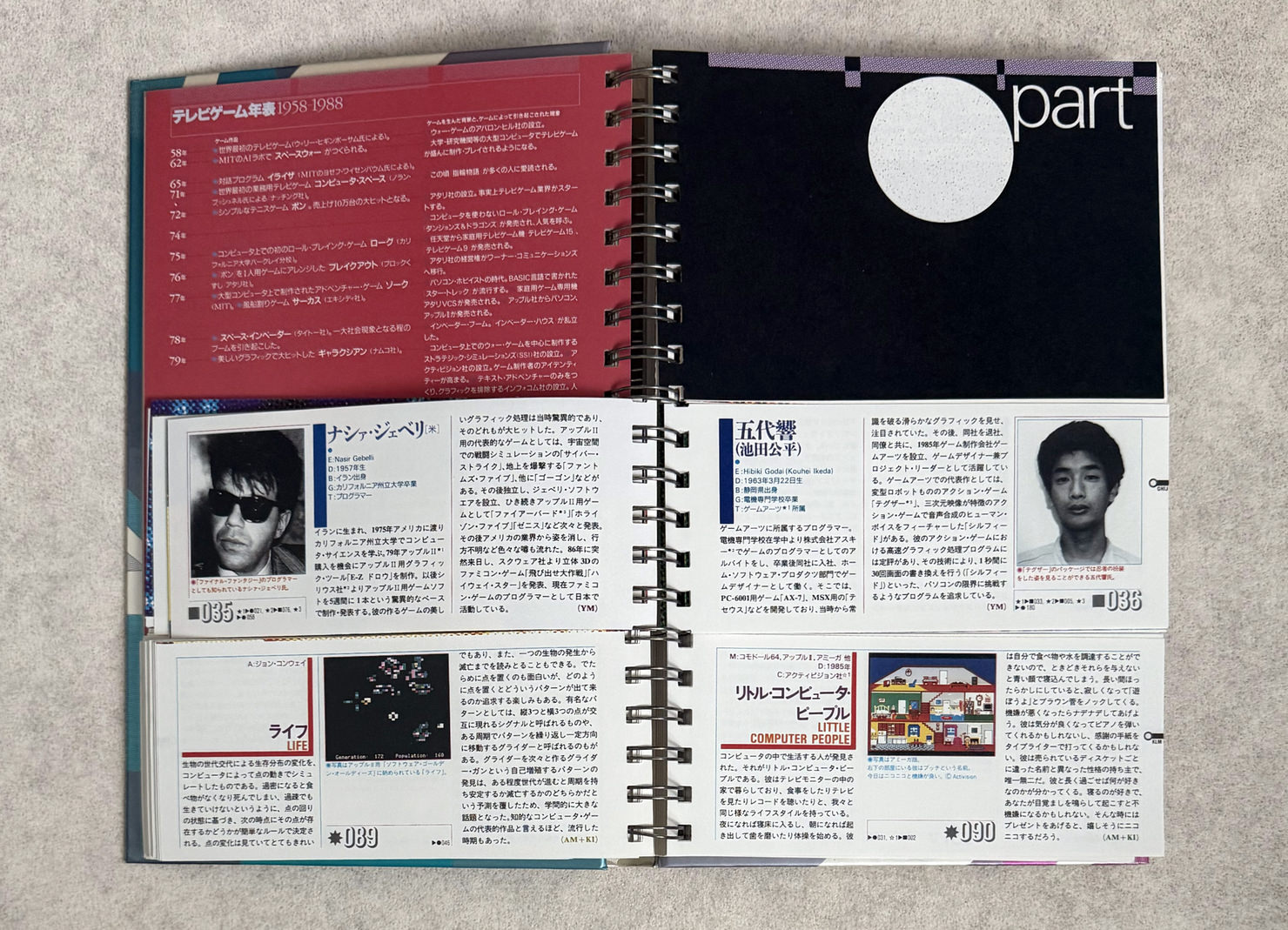
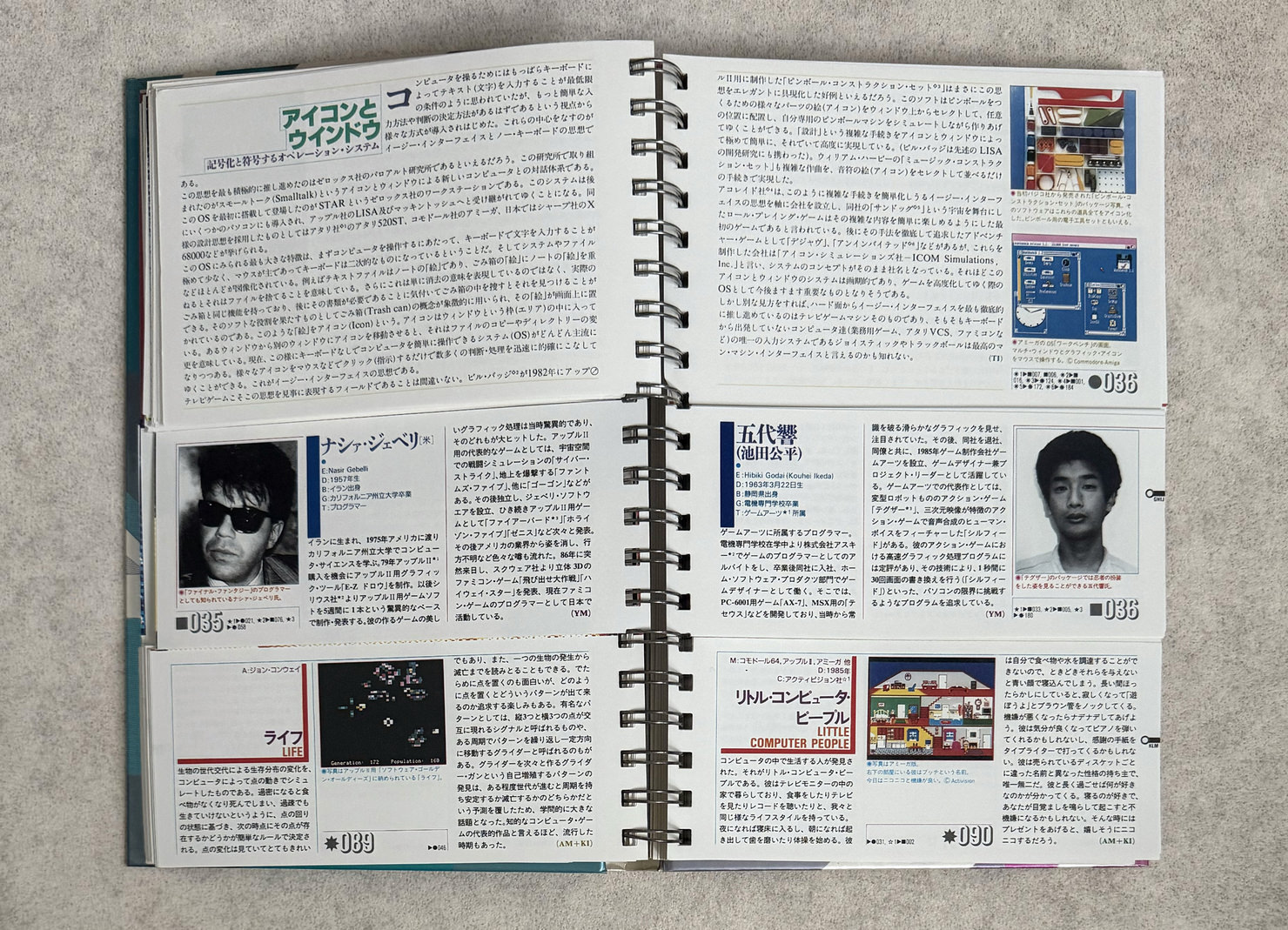
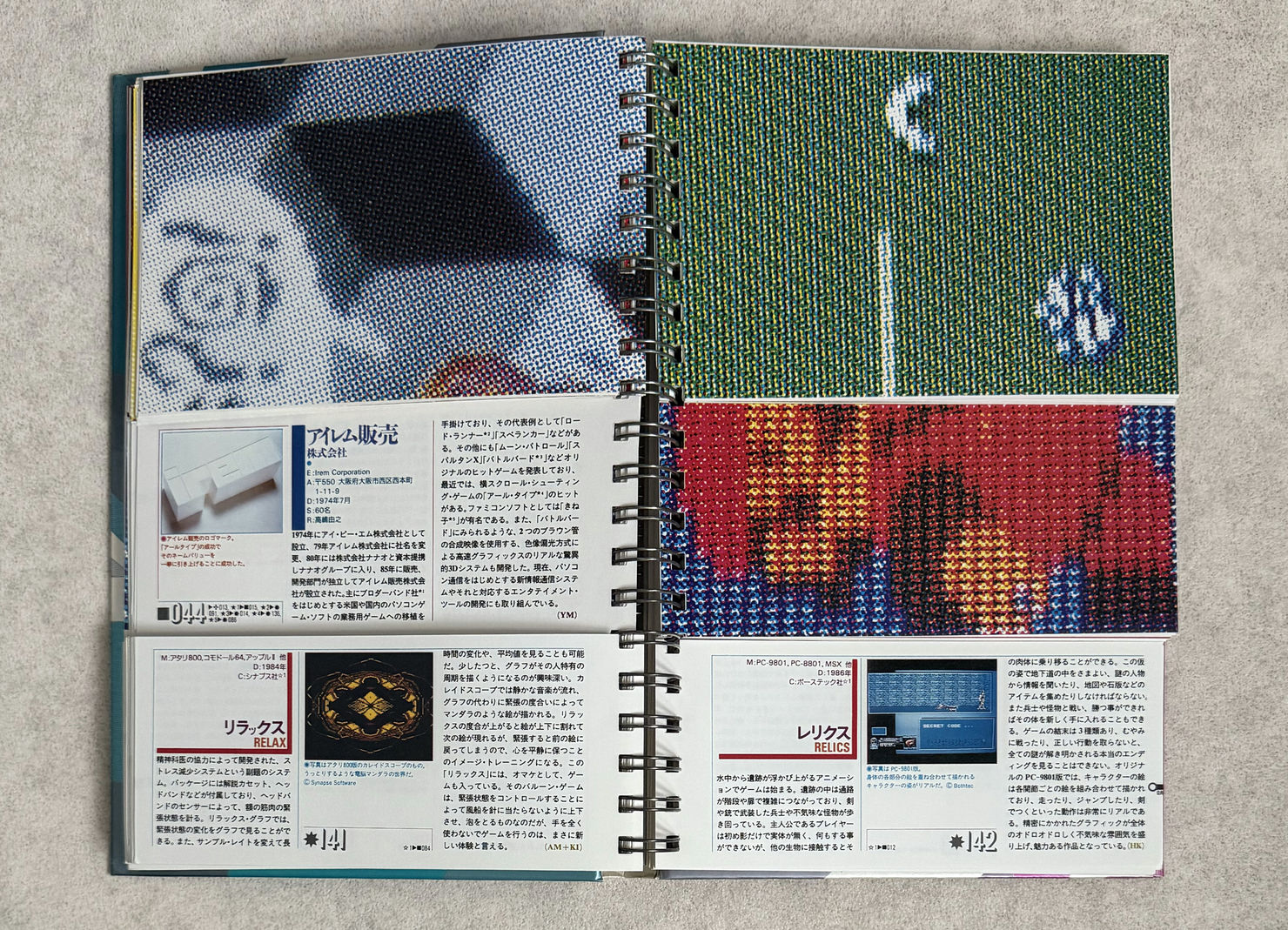
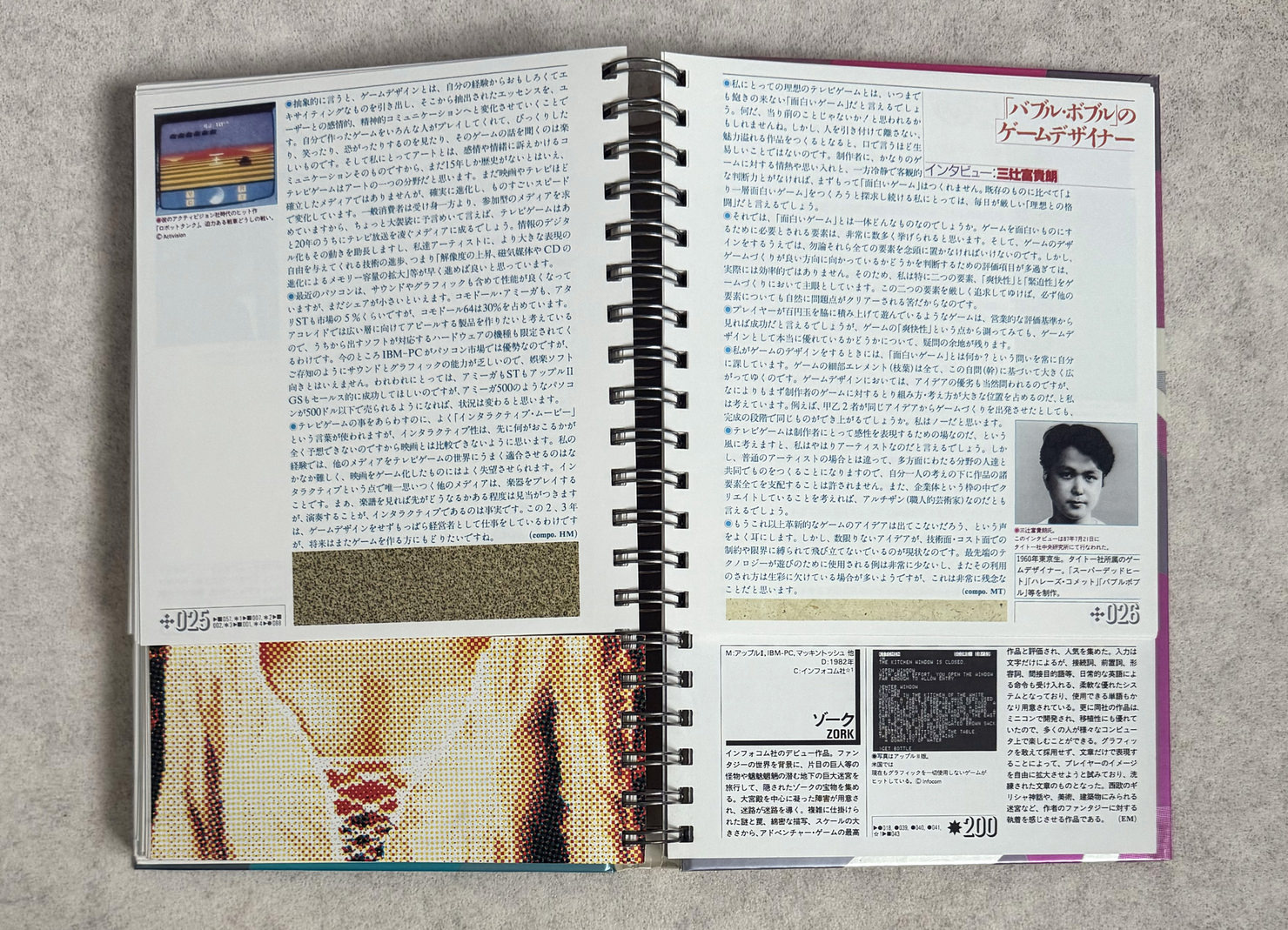
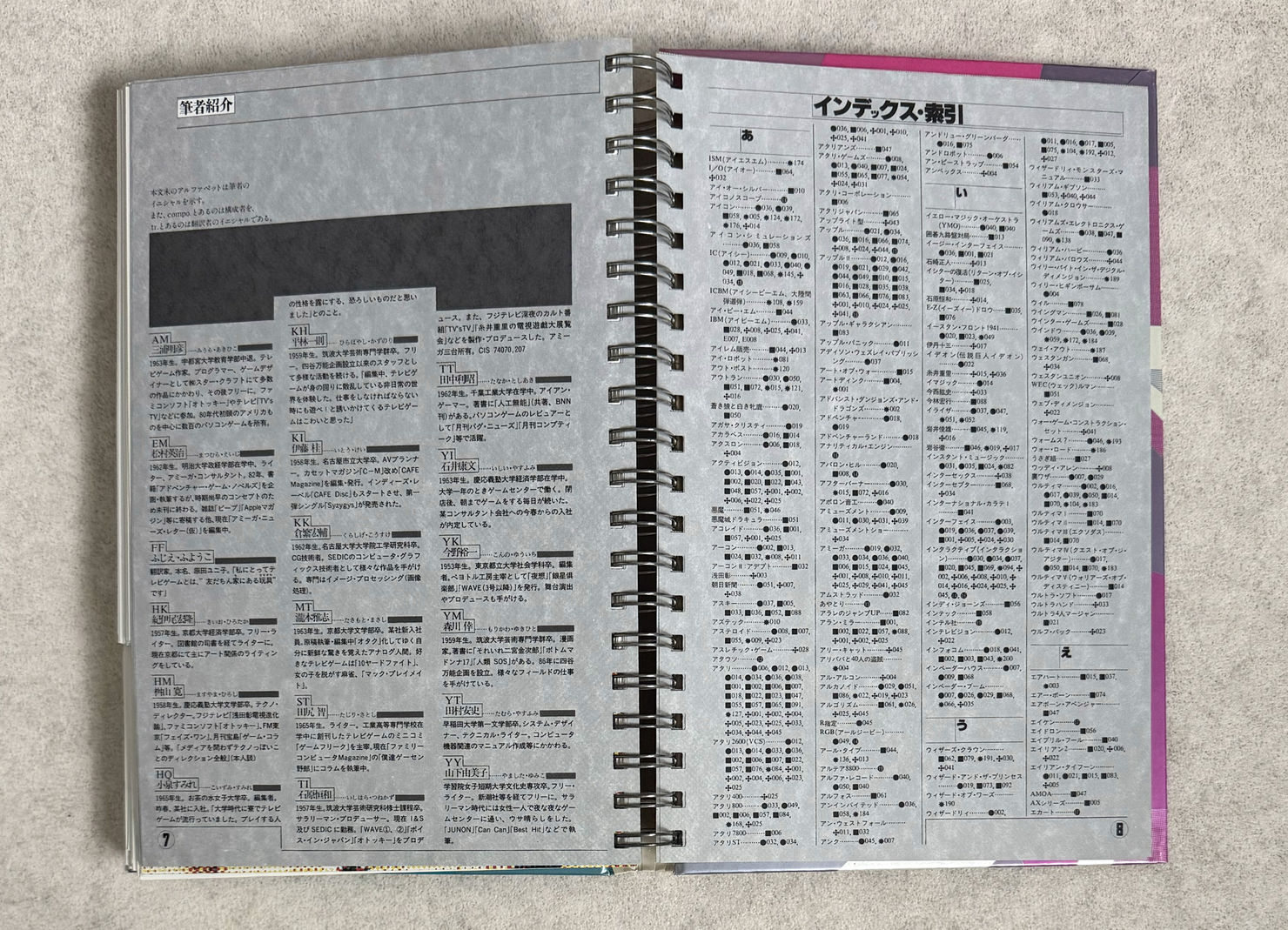
The book is extravagantly packaged in a frosted plastic slipcase and printed on a variety of paper stocks. It contains a host of different print techniques, finishes, and folds—and, most obviously, it is ring-bound with the majority of pages split into three horizontal sections. Unusually for a Japanese book from this period, it reads from left to right in the Western manner.
This makes reading the book an experience like nothing else. Pages are linked with cross-references, giving it a game-like, exploratory feeling. At various points, atmospheric photographs of games taken off cathode ray tube screens are spread across three separate panels, but the panels are distributed almost randomly throughout the book—making it a sort of puzzle to be able to view the whole image.
Imagine a hyperactive version of a choose-your-own-adventure book, or a paper-based website before the age of the internet.
The book was designed by Hitoshi Suzuki (鈴木一誌), one of Japan’s most influential book designers—a protégé of Kohei Sugiura (杉浦 康平) known for radical editorial layouts. Phototypesetting was by Masaaki Inoue (井上聖昭), with design assistance from Takao Kabaya (蒲谷孝夫).

The name
The title is doubled: first in modern katakana (テレビゲーム, terebi gēmu) and then in classical kanji (電視遊戯大全, denshi yūgi taizen—literally “electronic play grand compendium”). The former is how Japanese people actually say “video game”; the latter is an archaic, almost scholarly construction. The juxtaposition is deliberately playful.
The structure
The main body of the book is divided into four parts:
| KEY | Section | Description |
|---|---|---|
| ● | History | The history of video games, from Willy Higinbotham’s tennis game through Space Invaders, the Atari VCS, Apple II, and the Famicom |
| ■ | Creators | Companies and key developers |
| * | 200 Games | Two hundred selected titles across all platforms |
| + | Interviews & Columns | In-depth conversations with creators and essays on game culture |
Because every page is physically split into three sections—and each section carries jump signs pointing to related content elsewhere—you don’t read the book linearly. You follow threads. Top section might be history, middle section a company profile, bottom section a game entry, and the cross-references send you bouncing between all three. It is, in the most literal sense, a hypertext document published five years before Mosaic.
The content
All contemporary platforms of 1988 are covered, and crucially the focus is worldwide rather than Japan-only, making it a comprehensive who’s who from the golden age of video games. The book documents over 200 games, profiles dozens of companies and creators, and contains what may be the richest set of developer interviews assembled in a single volume up to that point.
The people behind it
The book was planned and directed by Tsunekazu Ishihara (石原恒和), now president of The Pokémon Company, and produced by the company SEDIC—the same outfit that developed the musical-platform game Otocky (1987), designed by Toshio Iwai. The creative thread connecting TV’s TV, Otocky, and this book is SEDIC and Ishihara’s circle: a group of people at the intersection of games, art, and media who understood video games not as disposable entertainment but as a cultural form worth documenting seriously. The team were also featured in the Tetris: Heavenly Scrolls book in 1989.
Among the book’s contributors was Satoshi Tajiri (田尻智), who later created Pokémon and is currently president of Game Freak. Tajiri had already established himself through his Game Freak fanzine as one of Japan’s most dedicated game critics, and his presence here—alongside Ishihara—prefigures the partnership that would eventually produce the world’s largest media franchise.
This is also the book that Tetsuya Mizuguchi cites as the genesis of his career in video games. Mizuguchi would go on to create Sega Rally Championship, Rez, Lumines, and Tetris Effect—a body of work deeply concerned with synesthesia, music, and the sensory experience of play. It’s not hard to see how a book this alive to the artistic possibilities of games might have lit that fuse.
A note on names
The book contains several misspellings of Western names, and at least one name that has since changed. For the record:
- Dan Bynten in the book → Danielle Bunten Berry (credited as Dan Bunten at the time; designer of M.U.L.E. and Seven Cities of Gold, she transitioned in 1992)
- Tossio Iwai in the book → Toshio Iwai (岩井俊雄; his own name is romanised inconsistently)
- Mark F. Flint — this is the pseudonym of the head of System Sacom, a Japanese game developer responsible for titles including Dome, Soft de Hard na Monogatari, and Xenon 2: Megablast (Japanese release). His real name remains unclear. The book contains what appears to be his only substantial interview—and possibly the only interview with him under any name!
The people list and interview list below use corrected/modern names.
People featured
Douglas Noel Adams · Don Bluth · Bill Budge · Danielle Bunten Berry · Nolan Bushnell · Douglas G. Carlston · Steve Cartwright · David Crane · Chris Crawford · Masanobu Endō · Mark F. Flint · David Fox · Richard Garriott · Nasir Gebelli · Hibiki Godai · Dan Gorlin · Satoshi Honda · Yūji Horii · Haruomi Hosono · Rob Hubbard · Toshio Iwai · Tōru Iwatani · Eugene P. Jarvis · Garry Kitchen · Yoshio Kiya · Timothy Leary · Ed Logg · Alan R. Miller · Shigeru Miyamoto · Kazuo Morita · Paul Murray · Kōichi Nakamura · Tomohiro Nishikado · Kazunori Sawano · Tom Snyder · Kōichi Sugiyama · Takanari Suzuki · Tony Suzuki · Toshiyuki Takahashi · Bill Williams · Roberta and Ken Williams
Companies featured
Accolade · Activision · Artdink · ASCII · Atari · Atari Games · Avalon Hill · Bandai · Beagle Bros · Bothtec · BPS · Brøderbund · Chat Noir · Electronic Arts · Enix · Enzan-Hoshigumi · Epyx · Firebird Software · Free Fall Associates · Game Arts · Game Studio · Hudson · Infocom · Irem · Koei · Konami · Kogado Studio · The Learning Company · LucasFilm Games · Mindscape · MIT · Namco · Nihon Falcom · Nintendo · Optimum Resource · Origin Systems · Sega Enterprises · Sierra On-Line · Silicon Beach · Sir-Tech Software · Sirius Software · Square · Strategic Simulations · Sublogic · Synapse Software · T&E Soft · Taito · Thinking Rabbit · Tokyo-Shoseki · Williams
Interviews
The interview section is the book’s crown jewel. It contains what are believed to be the only interviews ever conducted with several of its subjects—most notably Mark Flint (the enigmatic head of System Sacom). With rare input from people like Fukio “MTJ” Mitsuji (creator of Bubble Bobble, who died in 2008). For a number of the Western developers, these are the earliest known long-form interviews, predating the retro gaming preservation movement by over a decade.
- Accolade (Peter Doctorow)
- Activision (Jeffrey Mulligan, Richard Larberg)
- Activision & Sound (Russell Lieblich)
- Atari (Nolan Bushnell)
- Atari Games (Ed Logg)
- Atari Games Japan (Hideyuki Nakajima)
- Atari, Activision, Accolade (Alan Miller)
- Brøderbund (Douglas Carlston)
- Activision (Steve Cartwright)
- Bubble Bobble (Fukio “MTJ” Mitsuji)
- Electronic Arts (Trip Hawkins)
- Free Fall Associates (John Freeman, Anne Westfall)
- Irem (Mitsuri Kawai, Masato Ishizaki, Atsushi Yamazaki)
- LucasFilm Games (David Fox)
- Mind Mirror (Timothy Leary)
- Namco (Masanobu Endō)
- Nintendo (Shigeru Miyamoto)
- Nintendo Concepts & Future Developments (Hiroshi Imanishi)
- Door Door, Dragon Quest (Kōichi Nakamura)
- “Dragon Quest” (Yūji Horii)
- Galaxian (Kazunori Sawano)
- Pac-Man (Tōru Iwatani)
- Space Invaders (Tomohiro Nishikado)
- Strategic Simulations (Joel Billings, Randy Broweleit)
- Wizardry (Sir-Tech)
- Q&A (Bill Williams)
- “Copywriting” (Shigesato Itoi)
- “Future Video Games” (Toshio Iwai)
- “Video Games are Borderline” (Rika Kayama)
- Taito & PSG (Tadashi Kimijima)
- “Kind-Hearted Hackers” (Yūichi Konno)
- “Discovering Otaku, 1987” (Hiroshi Masuyama)
- “My Soliloquy” (Takao Momozono)
- “Invader Now” (Fumihiro Nonomura)
- TRON Real Time Operating System (Ken Sakamura)
- “Future of Games” (Izuo Sakane)
- “Games & Science Fiction” (Takao Shiga)
- Music & Games (Kōichi Sugiyama)
- “Luxury in Video Games” (Satoshi Tajiri)
- “Computer Culture” (Mitsuhiro Takemura)
Authors
| Init | Name | Romanisation | Notes |
|---|---|---|---|
| AM | 三浦明彦 | Akihiko Miura | SEDIC, Otocky. Game designer, Star Craft (MobyGames) |
| EM | 松村英治 | Eiji Matsumura | Writer, Amiga consultant (MobyGames) |
| FF | 原田ユニ子 | Fujie Fuyouko | Real name Yuniko Harada. Translator |
| HK | 紀伊尾宏隆 | Hirotaka Kiio | Freelance writer (MobyGames) |
| HM | 桝山 寛 | Hiroshi Masuyama | SEDIC, Otocky. Techno/director (MobyGames) |
| HQ | 小泉すみれ | Sumire Koizumi | Editor |
| KH | 平林一則 | Kazunori Hirabayashi | Freelance, Yotsuya Bannō Kikaku |
| KI | 伊藤 桂 | Kei Itō | AV planner, editor of CAFE Magazine |
| KK | 倉繁宏輔 | Kōsuke Kurashige | SEDIC, CG engineer |
| MT | 瀧本雅志 | Masashi Takimoto | I&S, SEDIC. Now Professor, Osaka University of Arts |
| ST | 田尻 智 | Satoshi Tajiri | Writer, Game Freak fanzine. Creator of Pokémon (MobyGames) |
| TI | 石原恒和 | Tsunekazu Ishihara | SEDIC, I&S. Now President, The Pokémon Company (MobyGames) |
| TT | 田中利昭 | Toshiaki Tanaka | PC game reviewer for Bug News, Comptiq (MobyGames) |
| YI | 石井康文 | Yasufumi Ishii | Student, Gamer |
| YK | 今野裕一 | Yūichi Konno | Editor, Peyotl Kōbō (夜想, 銀星倶楽部, WAVE) |
| YM | 森川 倖 | Yukihito Morikawa | Manga artist, Yotsuya Bannō Kikaku |
| YT | 田村安史 | Yasufumi Tamura | System designer, technical writer |
| YY | 山下由美子 | Yumiko Yamashita | Freelance writer |
It’s been scanned
There’s a scan on Internet Archive, though this won’t give you the full hypertext experience!
Contemporary references
Further reading/viewing
- Tetsuya Mizuguchi on how this book shaped his career (DenFamiNicoGamer, 2017)
- The Untold History of Japanese Game Developers — a related documentary project
- Shmuplations: Early Arcade Developer Interviews — featuring translations from this book
- Japan’s Bubble Era and Lost Decades (YouTube)
- Documentary: Japan’s Bubble Economy (YouTube)
- Japan’s Bubble Era in the 1980s (New York Times, 2018)
- Defining the Heisei Era (The Japan Times, 2018–2019): 1. Excess · 2. Hangover · 3. Introspection · 4. Pride · 5. Innovation · 6. Imagination · 7. Obsession · 8. Communication · 9. Family · 10. Solidarity · 11. Insecurity · 12. Peace
- Search mentions of the book on Twitter
- Our History of Internet, by Barbora & Sayawaka (2017), page 33
Buying the book today
The current price for the book is high, and varies quite a lot. It’s gone up since I bought my first copy in 2022. Whilst it’s almost unknown in the West the book continues to be fondly remembered and much sought after in Japan. Today you’re looking at somewhere between £200–600 GBP, or equivalent, depending on the condition. Some have cracked outer case, some are missing the correction insert, some have gone mouldy with age. But, up to now they have come up for sale often.
- Yahoo! Japan Auctions
- Mercari Japan classifieds
- Amazon Japan books
- Kosho book store search
- From Japan (offers reshipping worldwide)
- HOYOYO (offers reshipping worldwide)
Postscript
I’ve been working on this blog post on and (mostly) off since 2022. I’ll try to improve it over time!
Like what you read? Show your appreciation with ko.fi!
--
Comments: Twitter , Bluesky , Mastodon